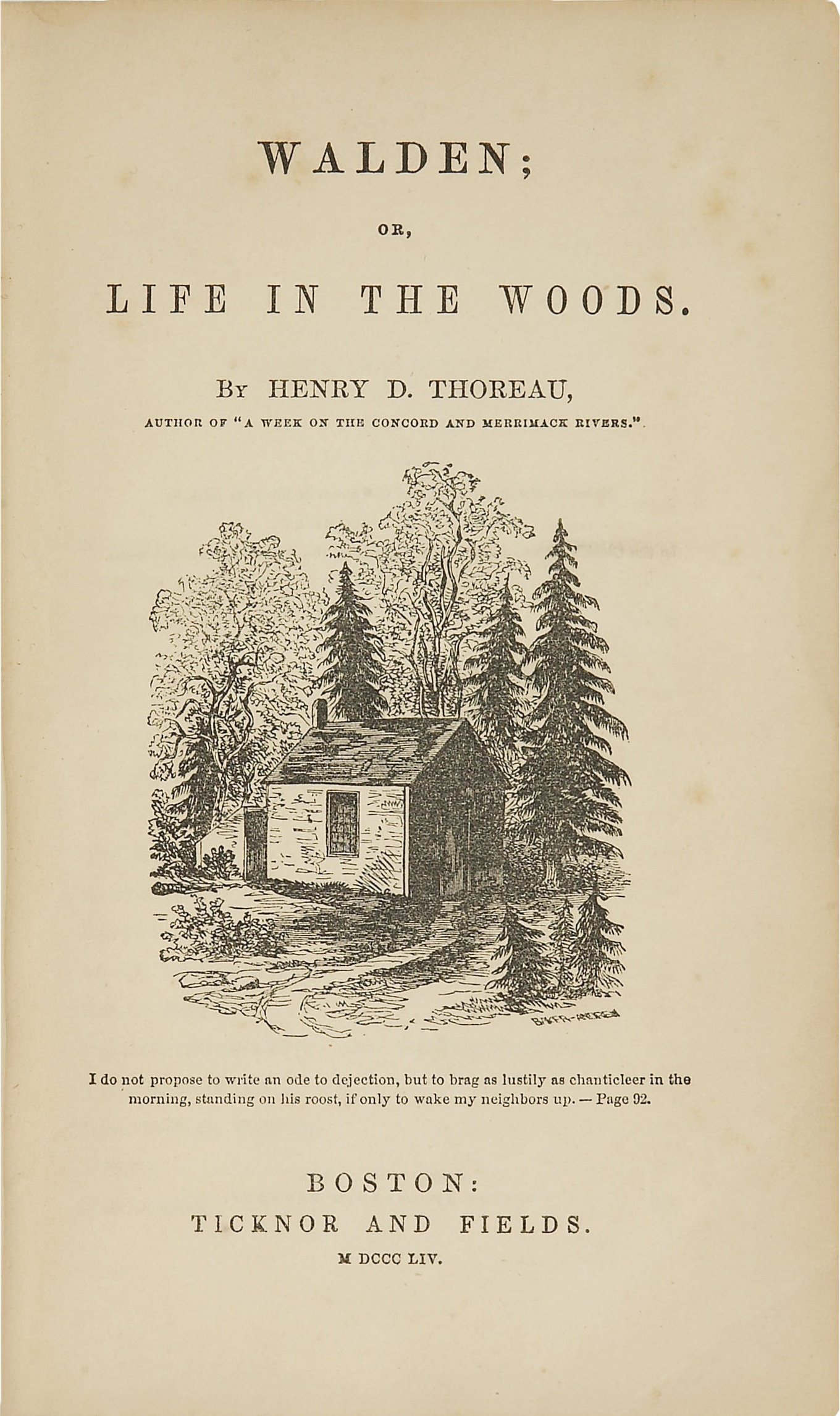
In an effort to revisit a book I didn't pay attention to when I was supposed to in High School (Sorry, Mr. Connolly), I recently read Walden. It is almost a meditative book to read as his writing style seems to exude the slow pace of everyday life in 1854; compared to now at least. While I do not recommend it for everyone, there are some lessons and passages that seem to be timeless enveloped in these pages. here's the cliff's notes of the more poignant ones:
“. . .This spending of the best part of one’s life earning money in order to enjoy a questionable liberty during the least valuable part of it reminds me of the Englishman who went to India to make a fortune first, in order that he might return to England and live the life of a poet. He should have gone up the Garret at once. ‘What!’ exclaim a million Irishmen staring up from all the shanties in the land, ‘is not the railroad which we have built a good thing?’ Yes, I answer, comparatively good, that is, you might have done worse; but I wish, as you are brothers of mine, that you could have spent your time better than digging in this dirt.” - pg. 50
“There are a thousand hacking at the branches of evil to one who is striking at the root, and it may be that he who bestows the largest amount of time and money on the needy is doing the most by his mode of life to produce that misery which he strives in vain to relieve.” Pg. 71
“I read in the Gulistan, or Flower Garden, of Sheik Sadi of Shiraz, that ‘they asked a wise man, saying: Of many celebrated trees which the Most High God has created lofty and umbrageous, they call none azad, or free, excepting the cypress, which bears no fruit; what mystery is there in this? He replied, Each has I appropriate produce, and appointed season, during the continuance of which it is fresh and blooming, and during their absence dry and withered; to neither of which states is the cypress exposed, being always flourishing and of this nature are the azads, or religious independents. –Fix not thy heart on that which is transitory; for the Dijlah, or Tigris, will continue to flow through Baghdad after the race of caliphs is extinct; if thy hand has plenty, be liberal as the date tree, but if it affords nothing to give away, be an azad, or free man, like the cypress.” Pg. 74
“ I know of no more encouraging fact than the unquestionable ability of man to elevate his life by a conscious endeavor. It is something to be able to paint a particular picture or carve a statue, and so to make a few objects beautiful; but it is far more glorious to carve and paint the very atmosphere and medium through which we look, which morally we can do. To affect the quality of the day, that is the highest of arts.” Pg. 85
“Time is but a stream I go a-fishing in. I drink at it; but while I drink I see the sandy bottom and detect how shallow it is. Its thin current slides away, but eternity remains. I would drink deeper; fish in the sky, whose bottom is pebbly with stars. I cannot count one. I know not the first letter of the alphabet. I have always been regretting that I was not as wise as the day I was born.” Pg. 92
“Every path but your own is the path of fate. Keep on your own track then.” Pg. 112
“This whole earth we inhabit is but a tiny point in space. How far apart, think you, dwell the two most distant inhabitants of yonder star, the breadth of whose disk cannot be appreciated by our instruments? Why should I feel lonely? Is not our planet in the Milky Way?. . . What sort of space which separates a man from his fellows and makes him solitary? I have found that no exertion of the legs can bring two minds much nearer to one another.” Pg 126
“You want room for your thoughts to get into sailing trim and run a course or two before they make their port. “ Pg. 133
“You only need sit still long enough in some attractive spot in the woods that al its inhabitants may exhibit themselves to you by turns.” Pg. 216
“What if all ponds were shallow? Would it not react on the minds of men? I am thankful that this pond was made deep and pure for a symbol. While men believe in the infinite, some ponds will be thought to be bottomless.” Pg. 271
“if one advances confidently in the direction of his dreams, and endeavors to live the life which he has imagined, he will mee with a success unexpected in common hours. He will put some things behind, will pass an invisible boundary; new, universal, and more liberal laws will begin to establish themselves around him and within him; or the old laws be expanded, and interpreted in his favor in a more liberal sense, and he will live with a license of a higher order of beings. In proportion as he simplifies his life, the laws of the universe will appear less complex, and solitude will not be solitude, nor poverty poverty, nor weakness weakness. If you have build castles in the air; your work need not be lost; that is where they should be. Now put the foundations under them.” Pg. 304/305
“Why should we be in such haste to succeed in such desperate enterprises? If a man does not keep pace with his companions, perhaps it is because he hears a different drummer. Let him step to the music which he hears, however measured or far away. It is not important that he should mature as soon as an apple tree or an oak. Shall he turn spring into summer? If the condition of things which we were made for is not yet, what were any reality which we can substitute? We will not be shipwrecked on a vain reality. Shall we with pains erect a heaven of blue glass over ourselves, though when it is done we shall gaze still at the true ethereal heaven far above, as if the former were not?” Pg. 307
“No face which we can give to a matter will stead us so well as the truth. This alone wears well. For the most part, we are not where we are, but in a false position. Through an infirmity of our natures, we suppose a case, put ourselves into it, and hence are in two cases at the same time, and it is doubly difficult to get out. In sane moments we regard only the facts, the case that is. Say what you have to say, not hat you ought. Any truth is better than make-believe. Pg. 308
“I love to weigh, to settle, to gravitate toward that which most strongly and rightfully attracts me – not hang by the beam of the scale and try to weigh less – not suppose a case, but take the case that is; to travel the only path I can, and that on which no power can resist me. It affords me no satisfaction to commerce to spring an arch before I have got a solid foundation. Let us not play at kittly-benders. There is a solid bottom everywhere. We read that the traveller asked the boy if the swamp before him had a hard bottom. The boy replied that it had. But presently the traveller’s horse sank in up to its girths, and he observed to the boy, ‘I thought you said that this bog had a hard bottom.’ ‘So it has,’ answered the latter, ‘but you have not got half way to it yet.’ So it is with the bogs and quicksands of society.” Pg. 310/311
“I went into the woods because I wished to live deliberately, to front only the essential facts of life, and see if I could not learn what it had to teach, and not when I came to die, discover that I had not lived. I did not wish to live what was not life, living is so dear; nor did I wish to practice resignation, unless it was quite necessary. I wanted to live deep and suck out all of the marrow of life, to live sturdily and Spartan-like, as to put to rout all that was not life, to cut a broad swath and shave close, to drive life into a corner, and reduce it to its lowest terms, and, if it proved to be mean, why then to get the world and genuine meanness of it, and publish its meanness to the world; or if it were sublime, to know it by experience, and to give a true account of it in my next excursion.” Pg. 85
“I left the woods for as good a reason as I went there. Perhaps it seemed to me that I had several more lives to live, and could not spare any more time for that one. It is remarkable how easily and insensibly we fall into a particular route, and make a beaten track for ourselves. I had not lived there one week before my feet wore a path from my door to the pondside; and though it is five or six years since I trod it, it is still quite distinct. It is true, I fear, that others may have fallen into it, and so helped to keep it open. The surface of earth is soft and impressible by the feet of men; and so with the paths which the mind travels. How worn and dusty, then, must be the highways of the world, how deep the ruts of tradition and conformity! I did not wish to make a cabin passage, but rather to go before the mast and on the deck of the world, for there I could best see the moonlight amid the mountains. I do not wish to go below now.” Pg. 304